
Thursley (30 May 2026)

Following a very hot spell with record breaking May temperatures, 15 members met in the Moat Car Park at Thursley at 09.00 in already very warm sunshine with temperatures expected to top 28 degrees later in the afternoon. There were high hopes that we’d be able to see seven species especially linked to the Heathland habitat here; Woodlark, Tree Pipit, Cuckoo, Redstart, Hobby, Willow Warbler and Dartford Warbler.
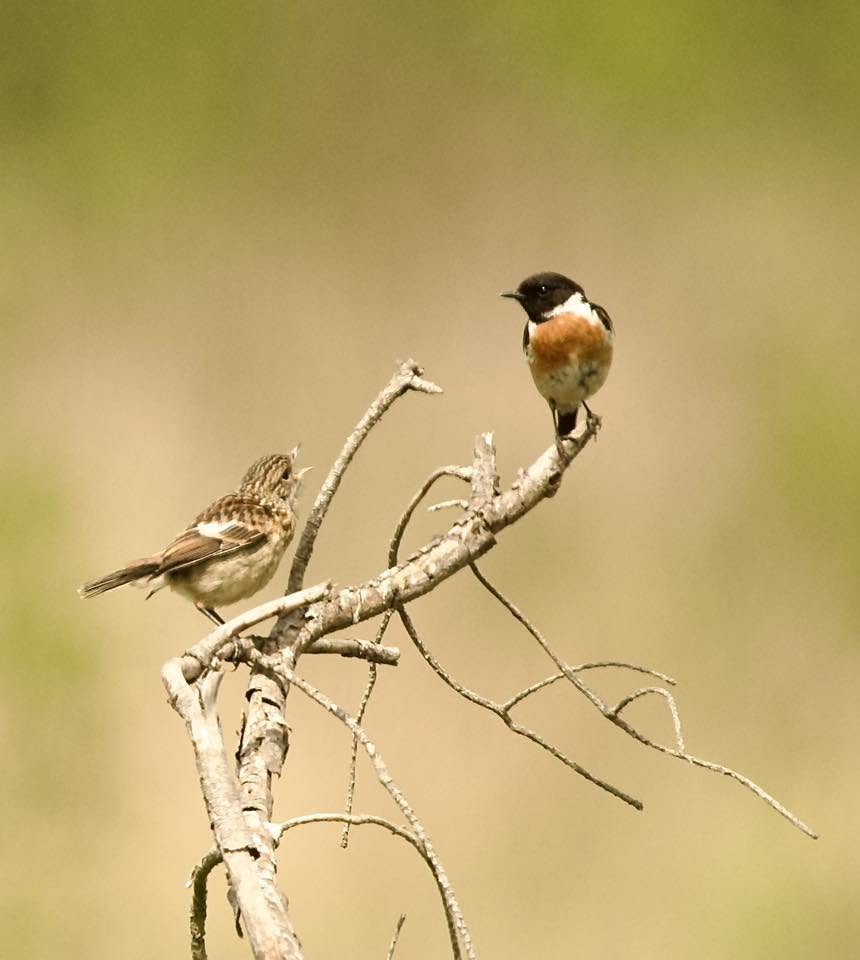
As we left the moat area and entered the reserve proper 3 Stonechats were quickly spotted and a distant Common Buzzard was thermalling the other side of the moat pond. Whilst everybody was watching the Buzzard, Gordon had very brief views of a probable male Goshawk flying away from us, unfortunately never to be seen again. This was followed by our first Heathland target species, a Woodlark, which was showing well on the telegraph wires occasionally singing, prompting a discussion as to whether Woodlarks or Skylarks were the best singers.
We followed the bridlepath stopping to view a small copse of pine trees. Our second Heathland target species, Tree Pipit, had already been seen by some of the group but we were all able to get distant views of the same bird singing from the top of a small pine tree. Three Mistle Thrushes which flew out of the pine copse were followed by a Green Woodpecker flying in the other direction. A male Redstart, the third of our target species, was seen very briefly and some intense scrutiny revealed a female in the same area; eventually the male reappeared although it was always active and most people only had fleeting views. Other birds seen included Whitethroat, Swallow, Blackbird and Chaffinch with a distant Cuckoo heard, our fourth target species.
As we progressed along the bridlepath our fifth target species, Dartford Warbler, played hide and seek with us and was only seen by a couple of people. In contrast our sixth target species, a Willow Warbler, was singing and calling from the top of a path side tree and was seen by everybody. Goldfinches were also seen but a singing Garden Warbler remained hidden.

A much more obliging Dartford Warbler was then located and seen by everybody and at the same time a Hobby, our final target species, was spotted high up in the sky successfully catching a succession of dragonflies. Another Tree Pipit was briefly heard in exactly the same tree as the previous two years, however this year it quickly flew further back into the trees and wasn’t seen. Another, closer, Cuckoo was heard calling continuously from behind another small copse of pine trees; the group followed the main path to try to view the back of the copse whilst Roy checked the other side. Fortunately for Roy, and unfortunately for everybody else, he’d made the right choice and had good views of the Cuckoo in a dead tree. Once he caught up with the group we retraced our steps but to no avail.
We then entered the much-needed shade of the small oak wood by the Parish Field where Rebecca pointed out both Redstart and Great Spotted Woodpecker nest holes. The young Great Spotted Woodpecker(s) were calling continuously, between feeds, and it/they were occasionally sticking their heads out of the hole. Speaking to a photographer on site he explained that the week before he’d been taking photos of a pair of Spotted Flycatchers attending their own nest hole but that the hole was now being used by a pair of Redstarts and he surmised that the Redstarts had manged to oust the Flycatchers and take over the hole. Eventually the male Redstart posed very nicely to everybody, sitting on a fence post. The male redstart was very territorial and would even chase off the much larger Woodpeckers with gusto. Whist watching the two nest holes both Garden Warbler and Blackcap were heard singing in the vicinity but neither were actually seen.
Leaving the shade and following the bridlepath fewer birds were in evidence as the temperature climbed, the only exception being a family party of five Dartford Warblers who showed well. At Pudmore Ponds, unusually no Hobbies were seen despite the large numbers of dragonflies there. A Skylark was initially heard and then seen singing from a small tree and other birds noted were Moorhen, Black Headed Gull and Tufted Duck whilst Reed Bunting and Little Grebe were heard. As we were approaching the end of the boardwalk we could hear Curlew calling and two birds were distantly seen circling and then landing by the ponds. Thursley is the only location in Surrey that they breed.
In the small area of pines near to the car park a Spotted Flycatcher was heard calling repeatedly but despite a 20 minute vigil the bird was never located and that also applied to a Fircrest in the same area. On the botanical front Southern Marsh Orchid spikes were identified close to the boardwalk and despite lepidoptera being represented by many Painted Ladies the only other butterfly seen was a ‘blue’ butterfly, tentatively identified as a Common Blue.
A lovely, albeit rather warm, walk was enjoyed by all having been enhanced by seeing most of the target species and, except for Roy, hearing the Cuckoos.
by Andy Roberts