
Medmerry and Pagham Harbour (30 March 2023)

Another R&T RSPB trip and yet another blustery day with rain threatening but our group of 11 were
undeterred. Medmerry is a ‘wild and wonderful’ reserve and as such has no facilities or hides so we
started our visit at nearby Pagham Harbour RSPB’s visitor centre. The pair of Kestrels using the nest
box behind the feeders entertained us as we waited for everyone to arrive. Sharing 3 cars meant
that we could squeeze into the small Easton car park at Medmerry and then follow the raised bank
all the way to the sea. Medmerry is the result of one of Europe’s largest, coastal realignment
schemes. In 2013 the sea wall was breached forming new intertidal habitats and a panoramic
landscape of mudflats, reedbeds and saltmarshes. The strong wind and time of year meant that it
wasn’t awash with birds but we still saw 43 different species and it was quite an adventure. Skylarks
battled on with their song in the wind and we saw a couple of Stonechat, Long-tailed Tits, a little
flock of Stock Doves, Lapwing, Rooks and a Collared Dove. Our best bird was seen almost in the car
park. A Yellowhammer picked out in the middle of a bush by it’s distinctive “Little bit of bread and no
cheese” song. A distant Marsh Harrier and Buzzard were spotted and a probable Corn Bunting didn’t
hang around long enough for more than a couple of us to see it. A few Shelduck were wandering
around and 6 Redshanks flew in before disappearing into a muddy channel. The Stilt Pool attracts all
sorts of rarities but we only had a few Avocets, a Little Grebe and the odd Teal and Shoveler. A
couple of hares, an unexpected Peacock butterfly and a Roe Deer, sensibly sitting in the lee of a
gorse bush, added some interest. When we eventually reached the sea, it was rough and a couple of
Herring Gulls were all we could see but if you look at the photo you will see lots of smiles as we
admired the wild view.


Retracing our steps to the car park we returned to Pagham Harbour visitor centre and made it inside
to eat our sandwiches just as the rain came down! The feeders were just about visible as the rain
streamed down the window and we could see Greenfinch, House Sparrow, Chaffinch and Blue and
Great Tits. After the downpour the weather improved and we had a look from the Ferry hide and
took a walk down the Ferry Channel. The highlight here was the Spotted Redshank which helpfully
posed next to an ordinary Redshank for comparison – paler (at this time of year), far more elegant
and with much longer legs. The large group of Black-tailed Godwit on the Ferry Pool were in all
stages of plumage from non-breeding to full breeding with that brick red colour spreading down
their breasts to their legs. Feeding Avocets were fascinating to watch as usual. Behind the pool a mix
of Black-headed and Mediterranean Gulls were feeding in the damp grassland and a Buzzard sat on a
post.
After a little circular walk, we drove down to Church Norton. The sun was nearly out by now and a
dozen Chiffchaffs, and possibly a Willow Warbler, were busy swooping silently for insects in the
semi-circular ditch that forms part of the remains of a Norman castle. Probably just arrived from
over the Channel, feeding up was their only focus; not singing which would have helped us
enormously. We spent quite a while looking at supercilia, leg colour and length of primaries as we
tried to separate Chiffchaffs from possible Willow Warblers. A good game!


On to the harbour and a good variety of waders, if not in big numbers – Curlew (but not Whimbrel
although we had one candidate), Grey Plover, Dunlin, Redshank, Oystercatcher, Turnstone and
Ringed Plover. The title of ‘smartest birds around’ was tied between the Mediterranean Gulls and
the Sandwich Terns – pure black heads and white bodies is a winning look! Although we were all
pretty tired by this point we decided that we should take a look at the sea before leaving. It was
considerably calmer than in the morning but only yielded a pair of Red Breasted Mergansers. Still,
looking at the sea in such a beautiful place is a good way to end any day.
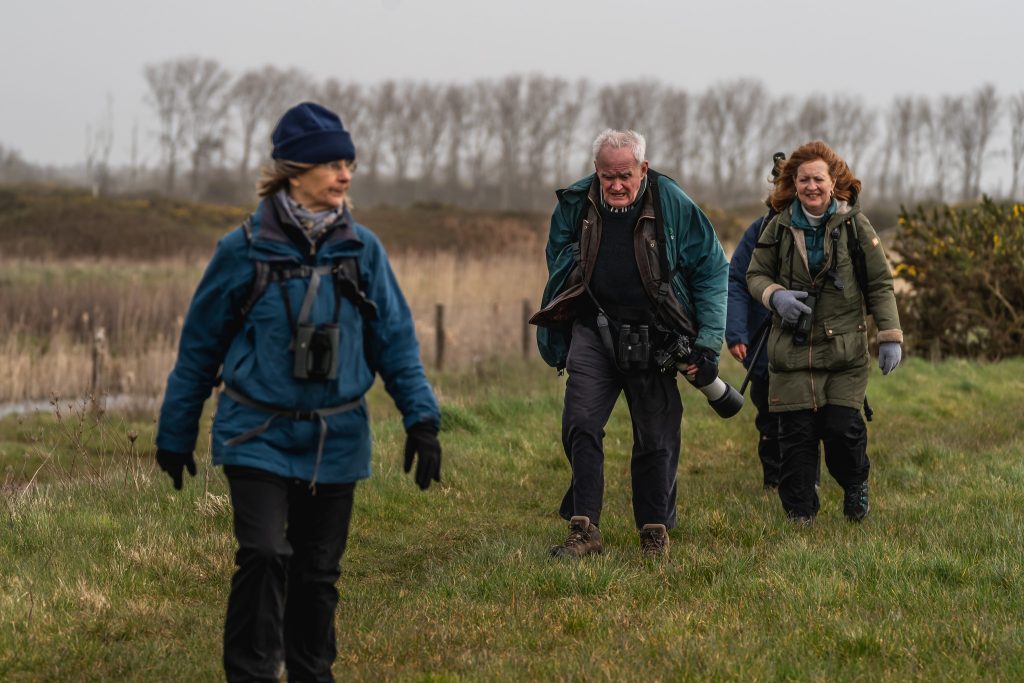
42 species at Pagham making a grand total for the day of 62+ different species
Species: Avocet, Black-headed Gull, Black-tailed Godwit, Blackbird, Blue Tit, Buzzard, Canada Goose,
Carrion Crow, Cetti’s Warbler, Chaffinch, Chiffchaff, Collared Dove, Coot, Cormorant, Curlew, Dunlin,
Dunnock, Gadwall, Goldfinch, Great Black-backed Gull, Great Tit, Green Woodpecker, Greenfinch,
Grey Heron, Grey Plover, Herring Gull, House Sparrow, Jackdaw, Kestrel, Lapwing, Linnet, Little
Egret, Little Grebe, Long-tailed Tit, Magpie, Marsh Harrier, Mallard, Mediterranean Gull, Moorhen,
Mute Swan, Oystercatcher, Pheasant, Red-breasted Merganser, Redshank, Reed Bunting, Ringed
Plover, Robin, Rook, Sandwich Tern, Shelduck, Shoveler, Skylark, Spotted Redshank, Starling, Stock
Dove, Stonechat, Teal, Turnstone, Tufted Duck, (possible Willow Warbler), Woodpigeon, Wren,
Yellow Hammer.
“I’d wanted to visit Pagham for a long time but we kinda got three for the ‘price’ of one yesterday.”
Lyn
“Thank you for a great day yesterday. Lyn, Diana and myself looked like tomatoes on the way back
from all that wind!! Can’t believe how many wonderful birds we saw – another real treat.” Ailsa.
by Rebecca Dunne