
London Wetland Centre (21 May 2025)

10 of us met on the bridge and in spite of overnight rain, we hoped for a good bird list. We started in the Observatory and were glad to see so many Sand Martins. There was one anomaly with white tail feathers that confused us for a while. These things happen in nature.
From the Dulverton Hide we were amused to see one Mandarin duck all by itself on the little stony island. We couldn’t understand why there was no vegetation on the island. The management must have decided to denude it to give better sightings.
We moved onto the feeders, where we saw a lot of baby Great Tits with their lovely washed yellow colouring.
In the WWF hide we noticed a distinct lack of Gulls. The Black-headed Gulls all migrate down the river to the nesting grounds in the estuary, at this time of year. When the tide came up on the Thames, we did see up to 20 Herring Gulls and one Lesser Black-Backed Gull.

At the Peacock Hide we settled down to do the bulk of our bird watching. There was a Great Spotted Woodpecker, intensely hammering away at a small tree. We thought he must have heard some big grub deep down in the wood as he spent nearly 15 minutes on the job. The lakes are in good condition at this time of year due to the management wanting to provide the very best habitat for the breeding birds.
Three cows are at work providing dung and management seem to have new equipment for harrowing up the marshland. We were disappointed not to see any Swallows or House Martins, but the brilliant Sand Martins make up for them. 95 holes in the bank are occupied this year. We watched in horror as a Magpie tried to enter one of their holes in the nest bank. He seemed to fail and dropped onto the ground where he found something to fly off with. The poor Sand Martins were most perturbed and refused to fly into the holes for a while. This caused a spectacular queue of flying birds.
During lunch at the café someone spotted a black dot very high in the sky. It proved to be a Hobby, which was then joined by another. It appeared they were grabbing something with their feet which could be dragonflies. We debated how high Dragonflies can fly. The “Net” suggests they can fly between 20,000 and 50,000 feet!!!!!
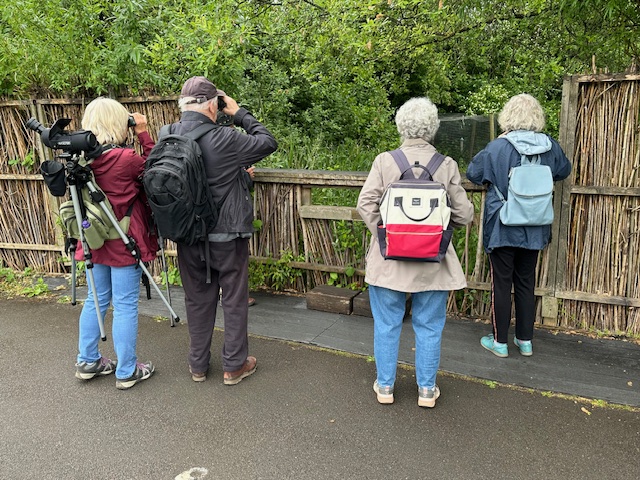
Our list inched up towards fifty which was quite pleasing.
Hot soup in the café completed a good morning’s birding.
by Christo Impey
List. In roughly the order we saw them.
Swan, Mallard, Parakeet, Crow, Reed Warbler, Feral Pigeon, Sand Martins, Moorhen, Chiff Chaff, Jackdaw, Starling, Swift, Robin, Great Crested Grebe, Cormorant, Tufted Duck, Coot, Canada Geese, Greylag Geese, Common Tern, Pochard, Kestrel, Shoveler, Oystercatcher, Grey Heron, Magpie, Herring Gull, 3 Little Ringed Plover, Reed Bunting, Great Tits, Juvenile Pied Wagtails, Gadwall, Cetti Warbler, Song Thrush, Blue Tits, Mandarin Duck, Blackbird, Long Tailed Tits, Greenfinch, Lapwing, Great Spotted Woodpecker, Little Egret, Wood Pigeon, Lesser Black-Backed Gull, Blackcap, Dunnock, Wren, Jay, Hobbies. 49.