
Langstone Harbour visit in support of Wader Conservation World Watch 2024 (3 November 2024)

A successful trip by 15 members in support of Wader Quest’s annual Wader Conservation World Watch. We did the same thing last year after an inspiring talk by Rick and Elis Simpson, the charity’s founders. All we had to do was to record the number of wader species we saw and to engage people in thinking about the plight of waders around the world. Many people stopped to ask what we were doing, mainly thinking that we were twitching something amazing, which gave us the opportunity to chat to them about waders. A very worthwhile day.
We visited 3 sites around the harbour on a murky, grey day. Brent Geese were ubiquitous, seen feeding on marine vegetation at each stop and making their soft gargling, guttural calls.
The Ship car park at Langstone Bridge, then walking past Langstone Mill Pond along the beach to Warblington as the tide came in.

The RSPB’s Oyster Beds at West Hayling Local Nature Reserve at high tide where we watched fantastic murmurations of waders as we ate lunch. A couple of students from Bristol joined us here, amazed at the wader spectacle and the views through our optics!
Farlington Marshes west side to the main lake to look at the high tide roost. Unfortunately, the flooding from last Spring has left is mark of Farlington with reed beds killed by the saltwater inundation and channels cutting through fields which forced us to turn back as we tried to walk from the lake towards ‘the hut’.
The walk to Warblington had perfect tide conditions that brought the birds nicely within view on the mudflats. Black-tailed Godwit, Curlew, Grey Plover, Lapwing, Oystercatcher, Redshank and a very distant Turnstone were our first waders. 8 Sandwich Terns sat with them, probably part of the increasing number that spend the winter along the south coast rather than migrating. Little Egrets and Common Gull added more interest along with Great Crested Grebes, Brent Geese, Teal and Wigeon out in the harbour. On the fields we found a Buzzard hunched in an Oak tree, lots of Stock Doves, a Stonechat and a Song Thrush perched on a hedge but unfortunately no Cattle Egrets, even though we walked all the way along to the cows by Warblington Church where they are often found. They breed in the heronry at the Mill Pond along with Little Egrets and Grey Herons which we did find on the pond. In the woods around the Mill Pond we added Goldfinch, Long-tailed Tit, Blue and Great Tits, a singing Chiffchaff that Roy and Molly imitated rather well and a pair of Reed Buntings which we heard singing from the reed beds before they flew off. This little walk is one of my favourites with the bonus of a good pub back at the car park!
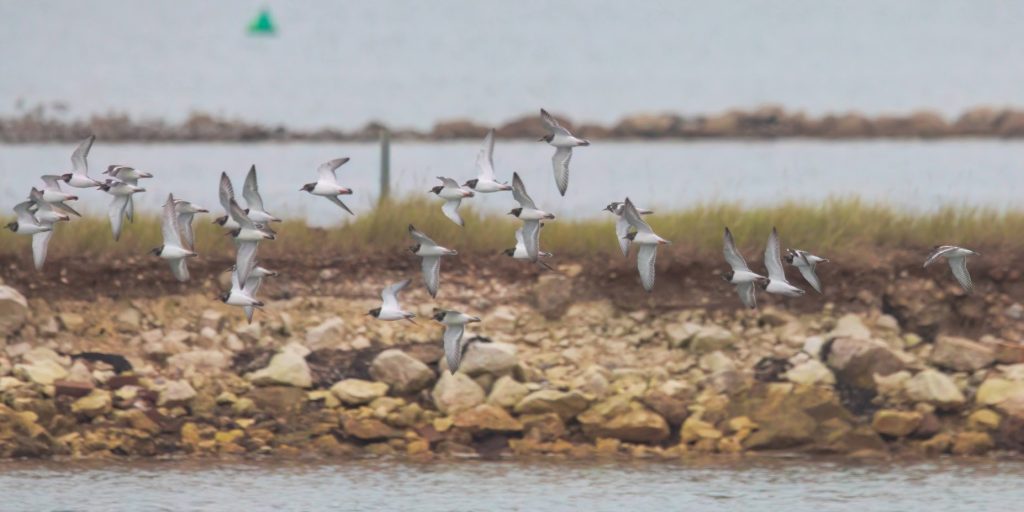
Our next stop, at the Oyster Beds, was the highlight of our trip. High tide was about 12:20 so the birds were at their most unsettled, flying up in swirls, aka the Snettisham Spectacular, as the rising sea pushed them off the tiny remains of spits. Here we had hundreds, if not thousands, of Dunlin and hundreds of Grey and Golden Plover along with better views of Turnstones, Redshank, Oystercatcher and a single Ringed Plover. A Kingfisher was a surprise, found fishing from the same little islands. Two Little Grebe were diving withing the old oyster beds. Scanning the distant harbour, those of us with telescopes spied the reported, Black-necked Grebe diving with a pair of Red-breasted Mergansers and a Great Crested Grebe. Luckily a further small group of Mergansers came much closer and gave everyone better views amongst the Brent Geese.
Our last stop at Farlington Marshes was going to struggle to beat the Oyster Beds for excitement but 2 fighting Grey Herons tried hard and a Great White Egret in the bleached reed bed was a nice surprise. The high tide roost of Redshanks included 8 Greenshanks and then a Buzzard put all the birds up giving us 3 Snipe as our last wader species. As the tide started to go out, small groups of Redshank flew over our heads back onto the emerging mudflats. Meadow Pipits and Skylarks could be seen on the fields and glimpses of a Snipe in a channel, but it was getting rather dark by this point, so we decided to call it a day and adjourn to a café at Petersfield Services. Not the most beautiful spot but convivial and warming after a very successful wader watch.

by Rebecca Dunne
70 Species including 12 waders: Black-headed Gull, Black-necked Grebe, Black-tailed Godwit, Blackbird, Blue Tit, Brent Goose, Buzzard, Canada Goose, Carrion Crow, Cetti’s Warbler, Chiffchaff, Common Gull, Coot, Cormorant, Curlew, Dunlin, Dunnock, Feral Pigeon, Gadwall, Goldcrest, Golden Plover, Great Black-backed Gull, Great Crested Grebe, Great Tit, Great White Egret, Green Woodpecker, Greenshank, Grey Heron, Grey Plover, Herring Gull, Jackdaw, Jay, Kestrel, Kingfisher, Lapwing, Little Egret, Little Grebe, Long-tailed Tit, Magpie, Mallard, Meadow Pipit, Moorhen, Mute Swan, Oystercatcher, Pheasant, Pied Wagtail, Pintail, Red-breasted Merganser, Redshank, Redwing, Reed Bunting, Ringed Plover, Robin, Sandwich Tern, Shelduck, Skylark, Snipe, Song Thrush, Starling, Stock Dove, Stonechat, Teal, Tufted Duck, Turnstone, Water Rail (heard), Wigeon, Woodpigeon, Wren