
Fishers Green (11 January 2025)
A small group of eight of us had a lovely trip to Fishers Green. It was the first time the R&T RSPB Group had visited this site in the Lea Valley, near Waltham Abbey.
The weather was lovely with bright sunshine all day and no wind. We had had the lowest temperatures of the year the night before at -5 degrees and the landscape was a winter wonderland with ice on the lakes and frost on the vegetation. Luckily there were small pools where the ice had melted in the main lakes, Seventy Acres and Holyfield, and these were packed with ducks.
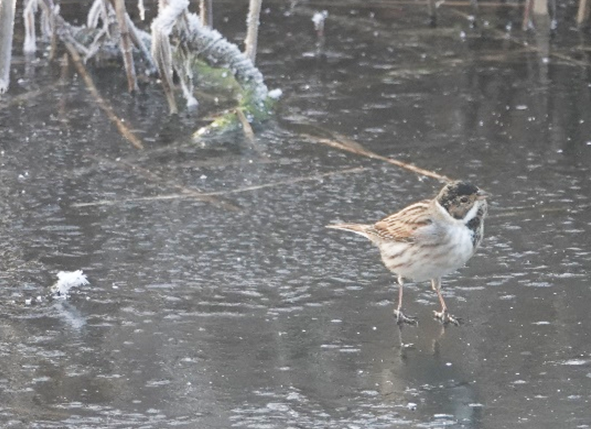
We started at the Discovery Hide which overlooks Seventy Acres Lake and also some reeds just outside, where Water Rail and Bittern often go between the nearby channels. Unfortunately we did not see Bittern but got glimpses of Water Rail and lots of Reed Buntings. Further into the lake were lots of ducks: over 300 Shoveler, Pochard, Gadwall, Mallard, Great Crested Grebe, Teal and Little Grebe. A highlight was seeing Moorhen looking quite comical running across the ice.
From there we followed the River Lea towards Holyfield Lake. We came across a mixed flock of Chaffinches, Great and Blue Tits, Treecreeper and Long-tailed Tits. At Holyfield Lake we could see a pool of water that was not frozen through the telescopes and got good view of 12 Goosander, lots of other ducks and almost a hundred Coot. We could also see a Fieldfare in a distant tree and a Buzzard perched low on a pylon.
We then followed the edge of the lake to Holyfield Weir, where we got a good view of a male Goldeneye feeding and distant groups of ducks and Canada Geese. We then followed the flood relief channel and saw another male Goldeneye feeding close to us in the channel, a Great Spotted Woodpecker and a good view of one of the many Muntjacs we saw during the day.
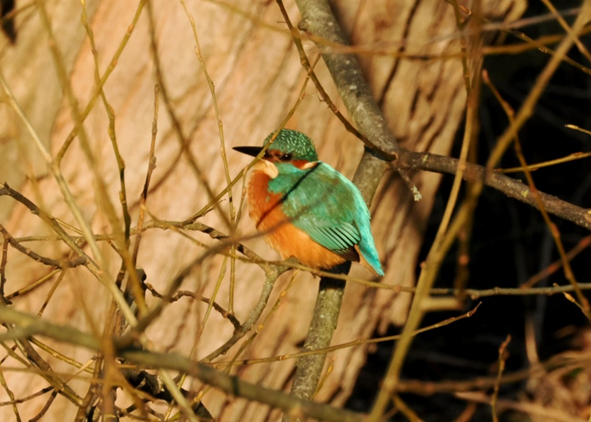
We then returned to the Discovery Hide for lunch and got good views of Water Rail, Tits and Reed Bunting. Just outside we got excellent views on a Kingfisher perched above the river bank for over 15 minutes, looking stunning in the bright sun. This pulled in the crowds and we lent out our binoculars to passers by, who were suitably impressed!

From there we took a path towards the café that overlooked farmland. In the fields we saw more Fieldfare, a Pheasant, a Song Thrush showing up well in the sunlight, a Kestrel and a Red Kite. We also saw a lot of Redwing busily throwing up leaves and feeding on the ground in woodland, with Goldcrest flitting about in the trees nearby.
After tea at the café we walked back to the car park, and there were over 50 Redwing roosting in the trees while the scene was glorious with the sun setting on this bright sunny cold day. Our ‘short day trip’ had lasted until sunset as there was so much to see and no-one was in a hurry to leave.
Everyone agreed it was a great day’s birding, and wanted to visit again.
by Dave Woods
Altogether we saw 51 species: Black Headed Gull, Blackbird, Blue Tit, Buzzard, Canada Goose, Carrion Crow, Chaffinch, Chiffchaff, Coot, Cormorant, Dunnock, Egyptian Goose, Feral Pigeon, Fieldfare, Gadwall, Goldcrest, Goldeneye, Goldfinch, Goosander, Great Crested Grebe, Great Spotted Woodpecker, Great Tit, Grey Heron, Herring Gull, Jackdaw, Jay, Kestrel, Kingfisher, Lesser Black Backed Gull, Little Grebe, Long Tailed Tit, Magpie, Mallard, Moorhen, Mute Swan, Pheasant, Pochard, Red Kite, Redwing, Reed Bunting, Ring-necked Parakeet, Robin, Shoveler, Song Thrush, Starling, Teal, Treecreeper, Tufted Duck, Water Rail, Wood Pigeon, Wren.