
Norfolk Trip (20-23 October 2024)

Sunday 20th October. We broke our journey to Norfolk with a visit to WWT Welney for a quick lunch and walk around the hides. The site was flooded, so most of us brought wellingtons but were happy with the two hides that were accessible. The bird feeders were covered with House and Tree Sparrows but first a Sparrowhawk, then a man on a mower, frightened them all away but they soon returned. In the Main Hide we were treated to a small murmuration of Black Tailed Godwits and we spied some Whooper Swans about half a mile away. There were plenty of ducks including some Pintails. From the café we found 3 Cattle Egrets with some cattle, but they were also a long way off. Telescopes were needed. There were no Cranes about, but they were expected to come in to roost just before dark.
At the Caley Hall Hotel everything was beautifully organised for the 24 Norfolk Trippers to check in and drop off our luggage in our rooms. We were soon off to see what was around at Thornham Harbour. The wind was blowing hard enough to topple one telescope but we saw a lot of shore birds before returning to the hotel for a hearty supper.
Monday 22nd October. The Snettisham Spectacular.
There were so many birders this year that the RSPB car park was full, and we had to go to the Beach Car Park. We should have taken Rebecca’s advice to download the JUSTPARK App as it was nigh impossible to see your phone and credit cards to pay in the dark. No matter, with modern technology, some of us paid later when having a coffee back at the hotel.
This year the Spectacular didn’t happen as planned because the tide was not quite high enough to push the Waders over to the back Lagoons. One has to remember that all tide tables are only predictions. No one knows exactly how high the water will come. The wind didn’t help because it was from the Southwest. However, we had marvellous views of huge murmurations of Knots out over the mud and immense numbers of Oystercatchers and other waders. On our walk back to the cars we came across a pretty cove covered with birds in huge numbers. Oyster Catchers and Knots on the far beach with a large number of Sanderlings and Turnstones on the near shore. A true delight.
After a welcome cup of coffee at the hotel, we all went on to Titchwell Marshes for a lovely afternoon in the sunshine. We decided to go straight to the beach and then work or way back along the lagoons. There was one Snow Bunting on the beach looking rather lonely, but we should realise they are well used to being alone. They fly across the North Sea from Scandinavia all by themselves. There had been another one earlier, but he had disappeared. Another lonely bird, a Gannet, flew up the coast as we enjoyed views of Grebes, Scoters, Divers and Gulls.

At the Paminder Hide, by the Freshwater Marsh, we were really close to over 1,000 Golden Plover. What a sight. They had been flying in a marvellous murmuration earlier on but were now peacefully resting on the mudflats. There were also Curlew, Avocets and many other waders. After a quiet cup of tea at the café, plans were made to search for Harriers on the Western Salt Marshes. There had been Great White Egrets earlier, but the evening highlights were at least 4 Marsh Harriers coming in to roost not far from the pathway and finally, a glorious sunset.
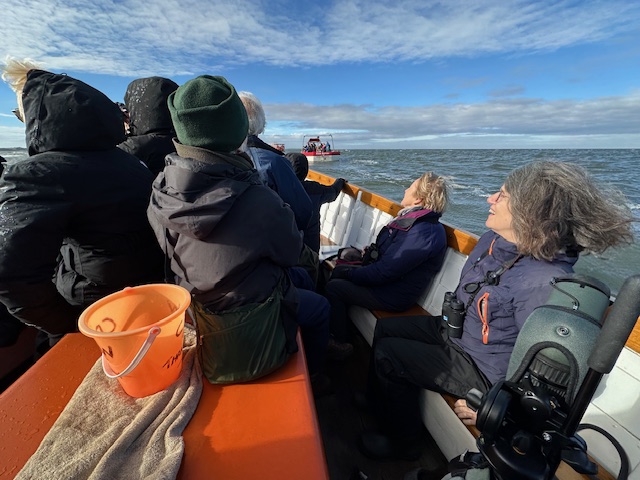
Tuesday 22nd October. We had a more leisurely start this morning to catch our seal trip boat from Morston Quay at 11:00. There were plenty of birds to see in the estuary but no rarities.
There was quite a fierce wind blowing and the captain found it tricky to get very close to the seals. The grey seals were all lounging about on the sand spit with several swimming close to the boat, presumably keeping guard. Most of the smaller, common seals have now migrated south to warmer seas but two had remained with their much larger cousins.

After a quick lunch at the Cley Marshes Visitor Centre we all split up to enjoy the hides with large numbers of birds to see. From the Daukes’ hide some of us had marvellous views of a Marsh Harrier coming straight towards us over the reed beds. Then a beautiful Kingfisher alighted right opposite us in the reeds and began to hunt. He got two tiny fish, and we were transfixed by his method of killing them by bashing their heads on his perch. Very efficient! There were reports of a Yellow Browed Warbler near the Snipe’s Marsh at the east end of the reserve. After a little look at the bird feeders, where we added all the usual suspects to our day lists, some of us trekked up the hill to find that Warbler. We finally turned back as we could see no sign of any birders huddled around a likely site. However, we did see a huge number of Rooks. As we got back close to the feeders, we suddenly found one birder hiding in the bushes hopefully on the lookout for the rarity. We didn’t have to wait long for a good sighting of two Yellow Browed Warblers, flitting about in the Willow trees just above our heads.
On our way back to the hotel we popped into Holme Dunes NWT to look for owls. We were rewarded by wonderful views of a Short Eared Owl quartering back and forth over the salt marsh. We then spotted a Barn Owl sitting quietly on a fence post. He must have had some early success because he just sat on that post for over half an hour not bothering to hunt at all.
We also saw a couple of Chinese Water Deer. These are interesting because the males don’t carry antlers but have incredibly long eyeteeth for defence purposes.

Wednesday 23rd October.
After checking out of the hotel most of us set off to Holme Dunes café where we parked up and visited the various hides looking over the saltmarsh. We found one Jacksnipe, but he was just hiding rather than bobbing up and down as they generally do. Some of us counted 7 Bearded Tits in the reeds but one had to have a lot of patience to find even one!
We then set off up the beach to look for a Kentish Plover that had been seen regularly over the past week. We had a marvellous hike along the beach to the estuary north of Thornham, but there was no sign of any Kentish Plover. However, it was well worth the walk to enjoy lots more birds including several Red-Breasted Mergansers, and to just be in such a fabulous place.
The cafe did a marvellous job providing lunch before we all said our goodbyes and set off back to West London.
A big thank you to Rebecca who had put in so much effort to make this excellent birding trip such a great success.
The group bird count was just short of one hundred species. See below.
by Christo Impey
Group List.
Avocet, Bar-tailed Godwit, Barn Owl, Black-headed Gull, Bearded Tit, Black-tailed Godwit, Black-winged Stilt (escape), Blackbird, Bluetit, Brent Goose, Buzzard, Canada Goose, Carrion Crow, Cattle Egret, Cetti’s Warbler, Chaffinch, Chiffchaff, Coal Tit, Common Gull, Coot, Cormorant, Curlew, Dunlin, Dunnock, Egyptian Goose, Gadwall, Gannet, Golden Plover, Goldfinch, Great Black-backed Gull, Great Crested Grebe, Great White Egret, Greenfinch, Greenshank, Grey Heron, Grey Plover, Greylag Goose, Herring Gull, House Sparrow, Jack Snipe, Jackdaw, Kestrel, Kingfisher, Knot, Lapwing, Lesser Black-backed Gull, Linnet, Little Egret, Little Grebe, Long-billed Dowitcher, Long-tailed Tit, Magpie, Mallard, Marsh Harrier, Meadow Pipit, Moorhen, Mute Swan, Oystercatcher, Pheasant, Pied Wagtail, Pink-footed Goose, Pintail, Pochard, Red Kite, Red-breasted Merganser, Red-throated Diver, Redshank, Reed Bunting, Ringed Plover, Robin, Rock Pipit, Rook, Ruff, Sanderling, Shelduck, Short-eared Owl, Shoveler, Skylark, Slavonian Grebe, Snipe, Snow Bunting, Sparrowhawk, Spoonbill, Spotted Redshank, Starling, Stonechat, Tawny Owl (heard), Teal, Tree Sparrow, Tufted Duck, Velvet Scoter, Water Pipit, Water Rail (heard),Whooper Swan, Wigeon, Woodpigeon, Wren, Yellow-browed Warbler.