
Knepp Wildland (2 July)
It was bright and breezy day as our group of eleven followed the 4.5km Purple Emperor Walk. It’s only open for a few weeks a year so as well as a chance to find these special butterflies it was also an opportunity to go through some of the wilder, less trampled, parts of the estate. You have to park in the field at the top of the drive now, but we’d already had soaring white storks, whitethroat, linnet and a yellow hammer singing away on a bramble thicket before we reached New Barn Farm. The farm provided maps, coffees, a helpful Safari walk leader who told us exactly where to look for purple emperors, house sparrows in nest boxes and great views of a stork nest. The two juvenile occupants were about to fledge and had been seen testing their wings and lifting off the nest, but not when we were there. They were only identifiable as youngsters by their dark beaks as opposed to the adults bright red beaks. Just a short way on a second stork’s nest had three juveniles preening away to prepare their plumage for flight. Although we didn’t pass any of the other eight nests, every so often a white stork or two would float overhead, some spiralling high on thermals.

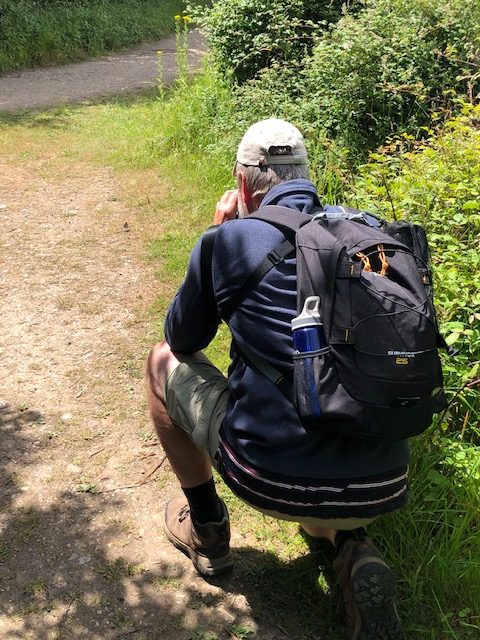
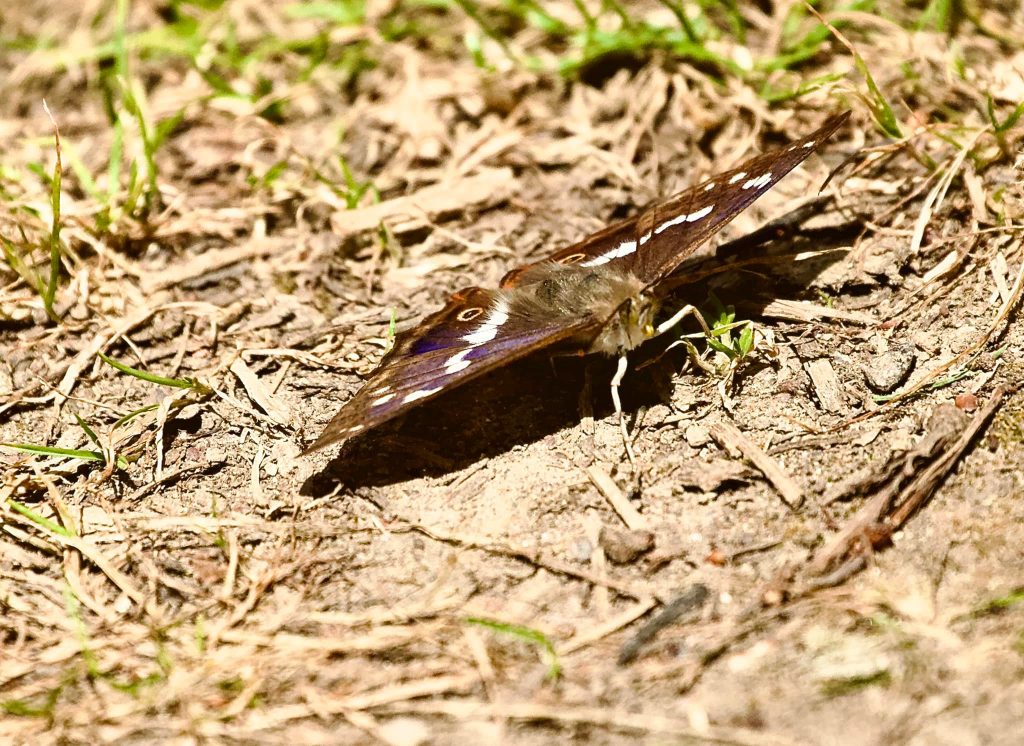
Purple emperors are having a good year with numbers apparently back up to 2018 levels and our walk certainly showed this. Following the purple route clockwise we soon came to Bentons Gorse Copse and its associated sallows and old oak trees. It’s one of the best areas to search in and so it proved; a male high up in an oak master tree (territory tree) then fantastic views of another male on less than beautiful pale excrement. It was obviously collecting all the minerals it needed and stayed for minutes eventually opening its wings in the sunlight to show us its purple hues. We found a tight bunch of either white admirals or emperors high in a nearby oak and emperors have been confirmed after Dave posted his photos on a butterfly group website. Fritillary butterflies proved equally controversial; were they dark veined fritillaries, silver-washed fritillaries or both? Probably the later judging by Knepp’s website. I just thought they were beautiful and easily confused with commas when glimpsed whizzing past. Butterfly species for the day threatened to outnumber birds and if you look on our group Facebook page you’ll find some great photos from Debbie, Dave, Jerry and Anita.
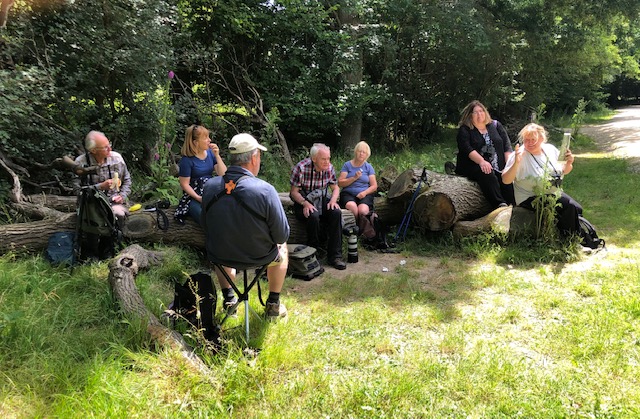
Green Lane Bridleway is often a good place to find both male and female purple emperors but apart from one chased out of sallows by a dog leaping into the pond nothing else was seen. Maybe it was a bit too windy? Still, the logs by the tree house platform provided a good stop for lunch where we saw hornets and a family of long tailed tits and heard nuthatch and a couple of garden warblers. A rootling Tamworth piglet was admired, particularly the noises it was making! From the tree platform many broad-bodied chaser dragonflies could be seen on the lake along with mallard ducklings. Follow the purple ribbons that mark the trail we soon turned off Green Lane and into the lush meadows and sallow thickets, interspersed with old oaks, that run behind the Hammer Pond and its feeder stream. Other walkers and volunteers pointed out a couple of guaranteed spots for Purple Emperors which proved correct. A female was seen egg laying on sallow and a male when we ‘put our backs to the bunting’ and sat on the grass looking up at a specific tree as instructed. A first gatekeeper butterfly for the year also caused much excitement. Bird wise we found a family of treecreepers in an oak tree and reed warblers sneaking through the reeds where the stream merges into Hammer Pond. My favourite thing though was dozens of emerald and bronze, iridescent Semaphore flies (poecilobothrus nobilitatus) on a tiny, muddy puddle on the path. The males had white spots at the ends of their wings which they flashed at the females in a courtship display.
As we neared the main Hammer Pond we found young swallows sitting on the telegraph wires in 27 Acres field. A Safari walk leader asked if we were looking at a turtle dove then explained that they nest nearby. Whilst having a sit down on the bank at the end of the pond two young great-crested grebes were seen being ferried around on a parent’s back. We had another look for the little owls, seen on our last visit, in a field by the farm but despite a helpful man who showed us ‘a guaranteed spot’ the owls stayed hidden. After six hours ambling along, we were all ready for refreshments and luckily the kiosk was still open. Once again, we enjoyed the comfy director’s chairs before heading back up the drive to the car park where we heard another yellow hammer singing behind a hedge. It wasn’t a brilliant day for birds, but not bad for July, and the butterflies and other insects more than made up for this.
Bird species: mallard, pheasant, swift, stock dove, woodpigeon, collared dove, stock dove, moorhen, coot, great crested grebe, white stork, red kite, buzzard, kestrel, great spotted woodpecker, magpie, carrion crow, swallow, long tailed tit, chiffchaff, reed warbler, blackcap, garden warbler, whitethroat, wren, nuthatch, treecreeper, blackbird, robin, house sparrow, pied wagtail, linnet, goldfinch, yellow hammer.
Butterfly species: white admiral, ringlet, comma, purple emperor, comma, red admiral, small heath, gatekeeper, speckled wood, meadow brown, marbled white, small skipper, silver washed fritillary.
By Rebecca Dunne