
Exminster Marshes, 2nd March 2024
A lot of us assembled, more than my fingers and toes, in the car park. It was a lovely sunny morning which is why, I guess, so many people appeared, as we were all saying “sun at last!”, although there was rather a biting wind.
It was a morning of geese and Curlew. Taking the latter first, there seemed to be Curlew everywhere on the grazing grass. This is encouraging as they are on the amber list, so it is nice to think that they are doing well here. They were surprisingly difficult to see, even if they are large birds, with their cryptic plumage blending in with the mud and grass. They will soon be back on their breeding grounds in the taiga of Russia and Finland.
Geese. Well, we saw a lot. To start the two white farmyard geese were in their usual place north of the fishermen’s car park, grazing away as they tend to. Then there were Canada Geese everywhere it seemed. Their rather greyish fronts looked white in the sun. They are very distinctive and are there all the year round.
Next up, the Brent Geese, quite a large flock, which we saw both on the ground and in flight. They are our smallest Goose, being 55 cm long and 105 cm wing span. They are dark, with a very distinctive white rump, clearly visible in flight. They will soon be off to their breeding grounds in Russia, Northern Europe, and Canada.
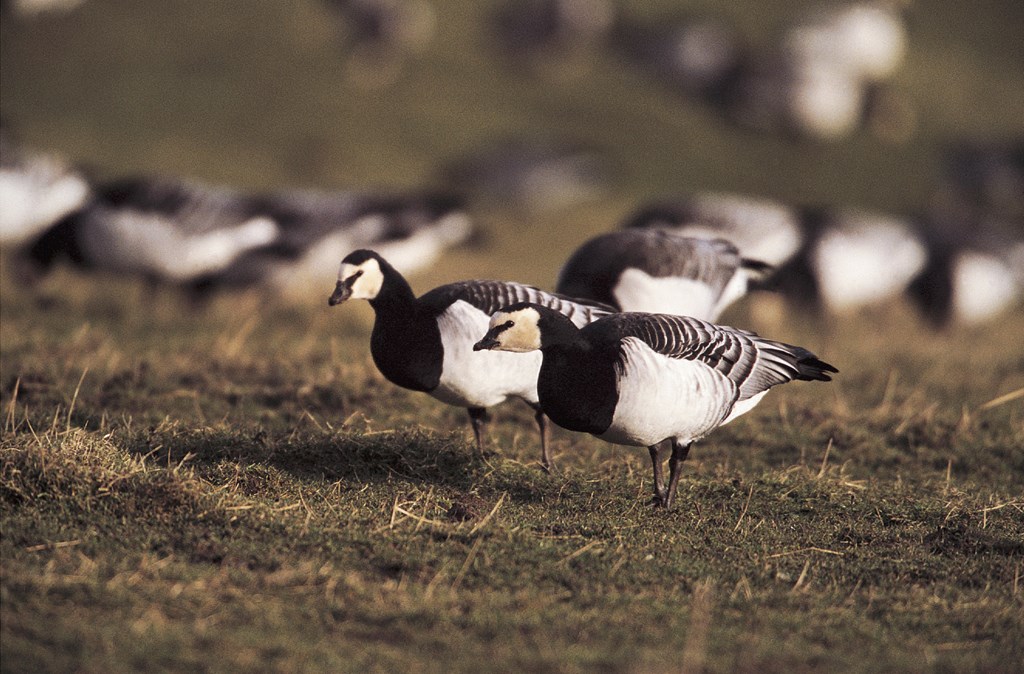
And finally, there were the stars of the show, Barnacle Geese. They are slightly bigger with a very distinctive white head, even visible in flight, as is the white belly. There were, apparently, 39 of them, which is very unusual on these marshes, so the local experts were excited. We saw them some way away, but very clearly through the scopes. Then they flew off over our heads, in formation and it was really obvious what they were.
Other that those it was a case of the usual suspects in small numbers. It was particularly disappointing that there were very few little birds in the trees; it was a lovely day, but very little bird song, a little concerning, I think.
Thanks to the two Richards for trying to control the rabble, and helping us with identification.
Ann Crawford
44 species seen: Pheasant, Brent Goose, Canada Goose, Barnacle Goose, Domestic Greylag Goose, Mute Swan, Shelduck, Shoveler, Wigeon, Mallard, Pintail, Teal, Tufted Duck, Wood Pigeon, Moorhen, Coot, Little Grebe, Curlew, Dunlin, Redshank, Black-headed Gull, Herring Gull, Cormorant, Grey Heron, Little Egret, Marsh Harrier, Buzzard, Magpie, Carrion Crow, Blue Tit, Great Tit, Skylark, Long-tailed Tit, Chiffchaff, Wren, Blackbird, Robin, Stonechat, House Sparrow, Dunnock, Pied Wagtail, Meadow Pipit, Chaffinch, Greenfinch.