
Canons Farm and Banstead Woods -Tuesday 13th October 2026
Our group of nine gathered at the end of Canons Lane in mild but damp conditions, thanks to a light drizzle. Having checked that the farmhouse barn was bereft of little owls we set off down the path next to Doric Field, heading into Copse Hill Lane.
Initially there was little to see beyond the odd distant corvid and woodpigeon, but as we approached the trees towards the end of the path avian activity increased. Most notable was a decent sized flock of linnets rising, circling and landing in the field stubble.

A few tits were moving through the branches, a chiffchaff, dunnock, and chaffinch were heard (four more of the latter were seen a little further along). A blackbird was strolling on the path ahead, apparently oblivious of us.
I decided that a brief diversion to see the (very extensive) abandoned Legal and General offices would be of interest. This post-modern structure was completed in 1991, but was only occupied until 2017 at which point it was given grade II status. An earlier building on the site was St Monica’s Boarding School for Girls. L&G bought the site in 1937 as an investment and added some offices after the war. It was a surprise to see lights in a small part of the centre of the building with two or three people working there, complete with computer. A few feral pigeons were using the roof tops as a vantage point.
We navigated around L&G Field back to the extension of Copse Hill Lane (with the former tennis courts initially on our right, behind the tall hedge). The trees and hedges here looked to be potentially attractive to birds, but were almost deserted. It is a popular place to let dogs run free which may be relevant. Apparently long gone was the once well-known owl box.
By now the drizzle had stopped and the sky looked a little brighter. We began to congratulate ourselves on having missed the worst of the predicted weather front. (I think you can guess what is coming later.)
The path now drops back to Reads Rest Lane, with a few corvids and magpie in the fields and tits and chiffchaff in the trees. This part of Reads Rest Lane is abutted by an extended stretch of bramble and scrub, and is often a good spot for stonechat among other small birds, including the start of one of the yellowhammer sites. Very little of anything on our visit, perhaps all the vegetation was still unpleasantly damp.
We were still only part way up the hill heading to Perrots Farm when the sky darkened, the tree branches began to rustle violently, and the clouds opened. However, it did not last long and soon we could see bright blue sky on the horizon, heading our way apace. Soon, and for the rest of the day, we would enjoy calm, sunny weather which at times was almost too warm. Gradually the birds began to respond also. Some of our group were fortunate enough to see four redwing as the weather was clearing.
From Perrots Farm we followed the plan of walking south, with Banstead Woods on our left, turn into the woods at the bottom of the field and gradually make an anti-clockwise circle back to Perrots.
On the first leg of this, out of nowhere there was suddenly a red kite above our heads.

Our entrance to the woods was into a relatively young section. Most of Banstead Woods is ancient woodland (and thought to have been owned by Anne Boleyn at one time).
The sight and sounds of birds was becoming more frequent again. This was my target area for marsh tits, (particularly as the age of the trees increased as we progressed) although initially we (and Merlin!) were only picking up things like robin, blue tit, great tit, long-tailed tit, goldcrest, and over in the valley, crow, jackdaw and green woodpecker.
Finally, almost when I thought we were running out of footpath, we heard clear and distinct high pitched cheeps unlike anything else, although not a typical marsh tit “sneeze”. Rather a single note of its usual extended call. Sure enough Merlin confirmed marsh tit, and we were able to hear, and with some effort, see two (probably) high in the branches. A highlight of the day.
With lunch time approaching my idea had been to exit the wood into an open area of attractive scrub (Fames Rough) which combines a beautiful view with a small bench which we would fight over. Unfortunately this area was locked off for animal grazing.
Two of the group knew of an additional bench further along, across Hillwood Field so we made for that, with sightings along the way including a jay in the sunlit branches, green woodpecker, and a clouded yellow butterfly.
There were actually two benches about fifty yards apart, one a traditional basic type without a back and one provided this year in memory of two labradors. We split and occupied both, with one group getting a very close green woodpecker and the other a distant couple of deer, almost certainly roe deer.
After lunch our route headed north through the woods, almost down to Park Farm before climbing back to Perrots Farm. All very pleasant but fairly quiet. But sometimes you just have to stop, look up and wait. And when we did we found the tree tops busy with blue tits, long-tailed tits and a nuthatch.
From Perrots farm we moved on towards Ruffets Wood, prior to which is often a good area for thrushes, though not on our visit. Mainly a scattering of corvids and woodpigeons again.
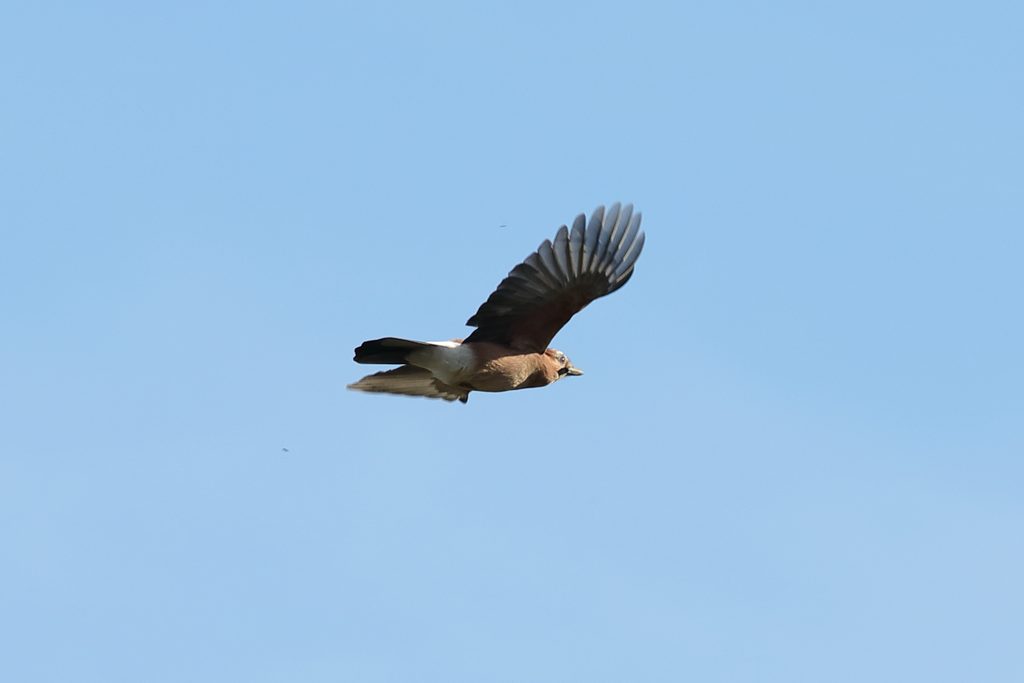
In the distance two buzzards could be made out, while another jay gave us a fly past.
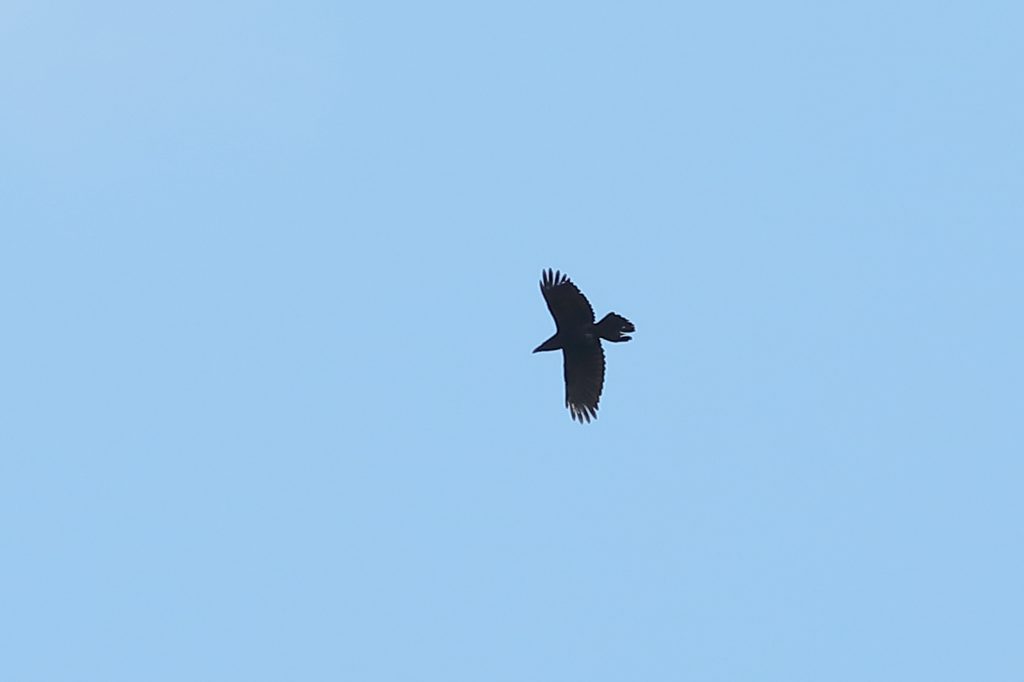
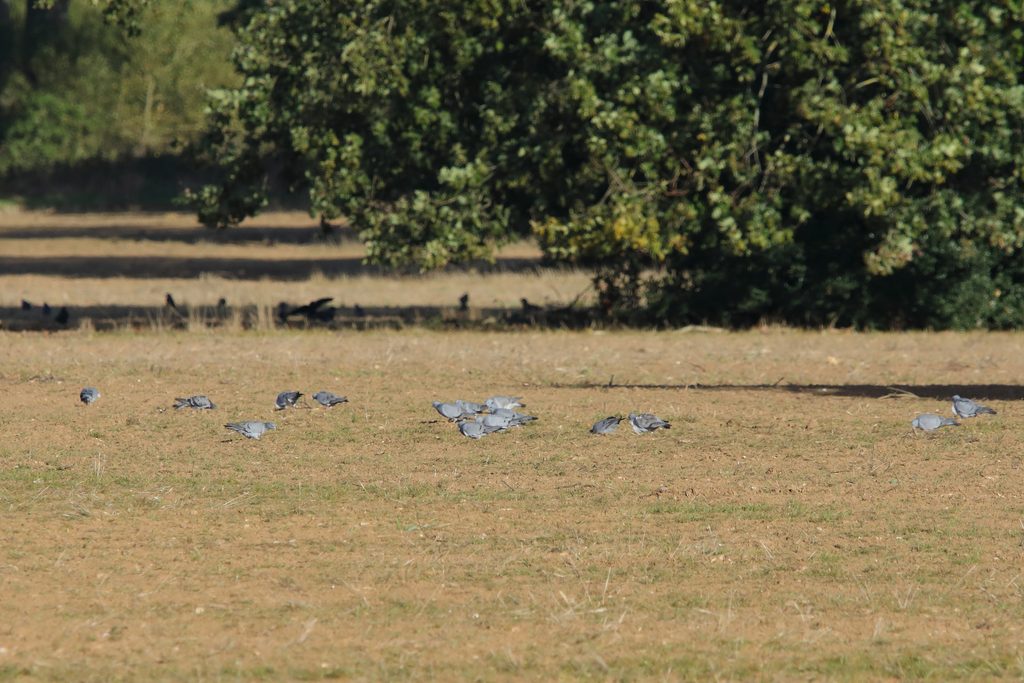
Before long we were walking along Lambert’s Field (a few woodpigeon and stock dove) and then along the path which cuts across Broadfield West. A raven flew quite high past us, initially quite difficult to identify as it had at least a couple of tail feathers missing.
Crows, the odd rook, and (mainly) jackdaws had gathered across the field, with a few pigeons and stock doves, with more stock doves grouped further round.
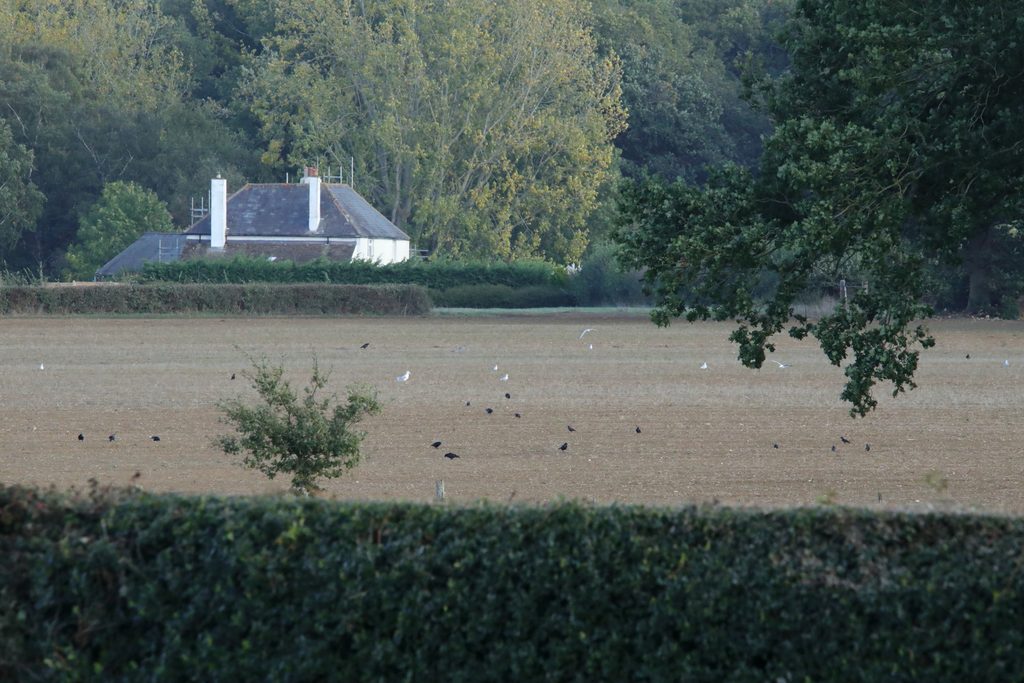
Way over to the right and further still beyond, corvids were augmented by a few gulls, impossible to identify at this stage.
It was around here we had the inevitable squawk of a rose-ringed parakeet, and the thin note of a meadow pipit.
Three of our group decided to take the track back to the cars for an early finish while the rest continued further along Broadfield (hoping, but failing, to get yellowhammer). However this was really where the action started to take off again.
Suddenly a buzzard began swooping over the birds in front of us, causing some panic among the stock doves (in fact one appeared to have been caught but then struggled free), while the corvids looked on wondering what the fuss was about. Even when the buzzard landed in their midst they could not care less. Eventually the buzzard took to a branch across the way, where we realised a second was perched a little higher up.

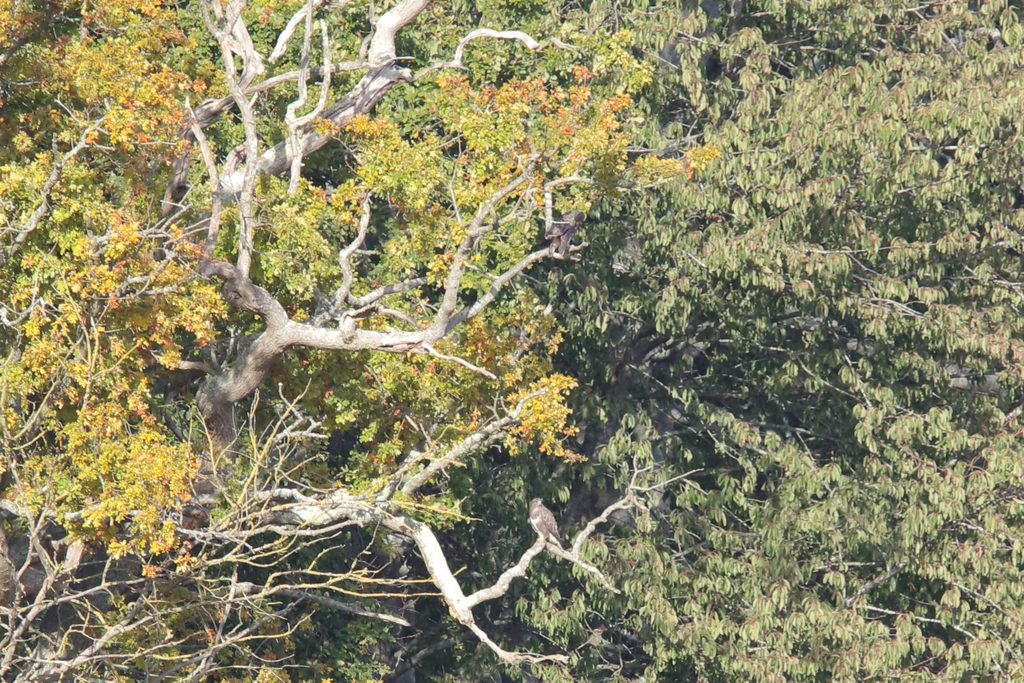
Smaller birds were also moving around on the ground closer to us, but difficult to see when they landed. Linnets, skylark and a few goldfinch. As we moved further along stonechats (at least four) began to appear, generally keeping to the hedgerow or the field nearby.

The gulls in the distant field had by now increased in number, and as we got closer we could see they were mainly black-headed gulls, but with one herring gull.
We were now back on Reads Rest Lane, heading to the cars, and thinking the show was over. Suddenly a raptor shot through a gap in the trees to our right, with the immediate sense it was a sparrowhawk. However a few seconds later a kestrel appeared further down the lane, being mobbed by a crow. Presumably this was what we had seen through the trees.

A great spotted woodpecker was also seen in a rather spindly tree.
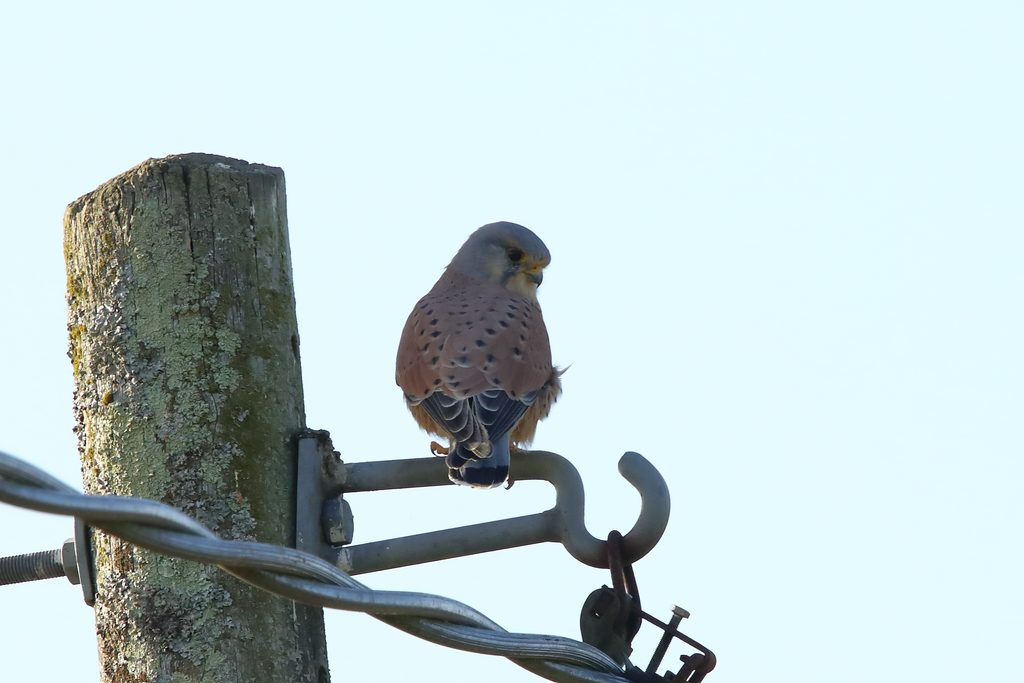
Finally back at the cars and almost ready to drive off, when another kestrel was called, sitting on a nearby telephone post until it had had enough of our staring.
My own very final sightings were house sparrows and four starlings by the houses on Canons Lane. Two of our party had actually parked there and seen them in the morning, so I knew what I was looking for.
Not an extensive list, and no real migrant surprises, but good to catch the marsh tits and raven, and once the rain had cleared an excellent walk in lovely sunshine.
Steve Grayson
Species lists
39 bird species
Common buzzard, Red Kite, Kestrel, Raven, Crow,, Rook, Jackdaw, Magpie, Jay, Blackbird, Robin, Linnet, Skylark, Stonechat, Chiffchaff, Goldfinch, Woodpigeon, Feral pigeon, Stock dove, Herring gull, Black-headed gull, Blue tit, Great tit, Marsh tit, Long-tailed tit, Nuthatch, Green woodpecker, Great spotted woodpecker, Rose ringed parakeet, House sparrow, Starling, Pied wagtail, Redwing, Chaffinch, Wren, Goldcrest, Meadow pipit, Coal tit, Dunnock
Grey squirrel, Roe deer,
Clouded yellow, (plus!)
Banks leaf beetle