
Staines Reservoir – Wednesday 9th September 2026
This outing was scheduled to be to Cuckmere on Tuesday 8th with Steve G as our leader. A series of unfortunate events led to a complete change. Firstly, Steve G was unable to go, so the leading devolved to Steve F and JB. As for the date, it became increasingly obvious that the forecast for the Tuesday was of heavy rain for much of the day; it may have eased off during the afternoon by which time participants would have been soaked. It also transpired that SF may not have been available. Finally, having looked at potential birds around it was decided that Cuckmere was a fair way to go with a chance that few birds would be seen. At the same time, news was filtering through that Staines Reservoir was partly drained exposing muddy islands that were being visited by good waders. That’s our excuse and we are sticking to it.

On the day, five of us assembled near the entrance to the causeway, just about squeezing into the limited car parking space. Soon after we got out of the cars, a Red Kite drifted around. Walking up the slope we had the first of what would be many Pied Wagtails. Scanning the reservoir from various points near the towers we added a mix of Coot, Gadwall and Tufted Duck along with a small flock of Mute Swans and a few Great Crested Grebes. We could also see that there were indeed islands on the south basin. As we started off along the causeway we chanced on a couple of Yellow Wagtails down the bank, while a single Swallow flew along. Little Grebe, Shoveler and Mallard showed themselves. We were looking out for a Black Tern that had been hanging around for a few days. At this point we met a fellow birder who told us where the tern usually could be found, but he hadn’t seen it either. He did, however, fill us in with news about waders on the main island we could see.
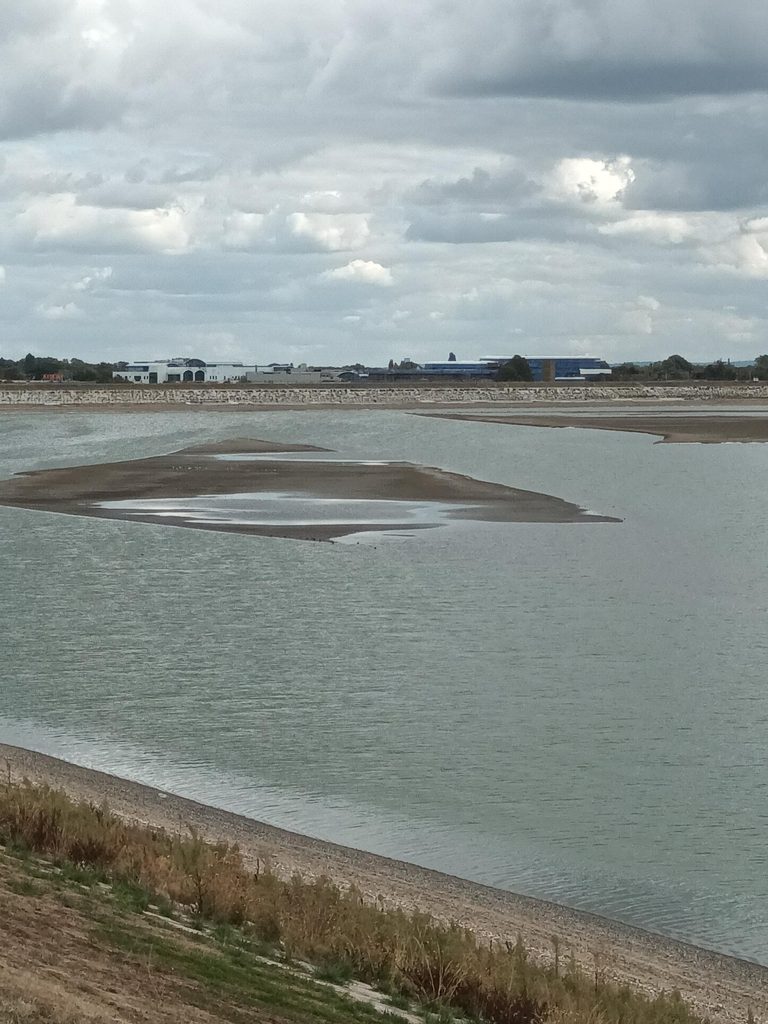
We continued to scan around as we headed further along. As we started to get clearer views of the islands we could see the waders. An initial glance by JB noticed a couple of Black-tailed Godwits, but this was the only time the group encountered them. Once we got closer we were scanning the mud quickly notching up Ruff, Dunlin, Ringed Plover and a few Knot. The Little Stints were harder to pin down so everyone could see them, but we succeeded. While searching for a target bird (more later) one wader gave itself away as a Curlew Sandpiper. A couple of Teal were located on an island and we realised that a large flock of Canada Geese, with a few Greylags were over towards the far southern bank.
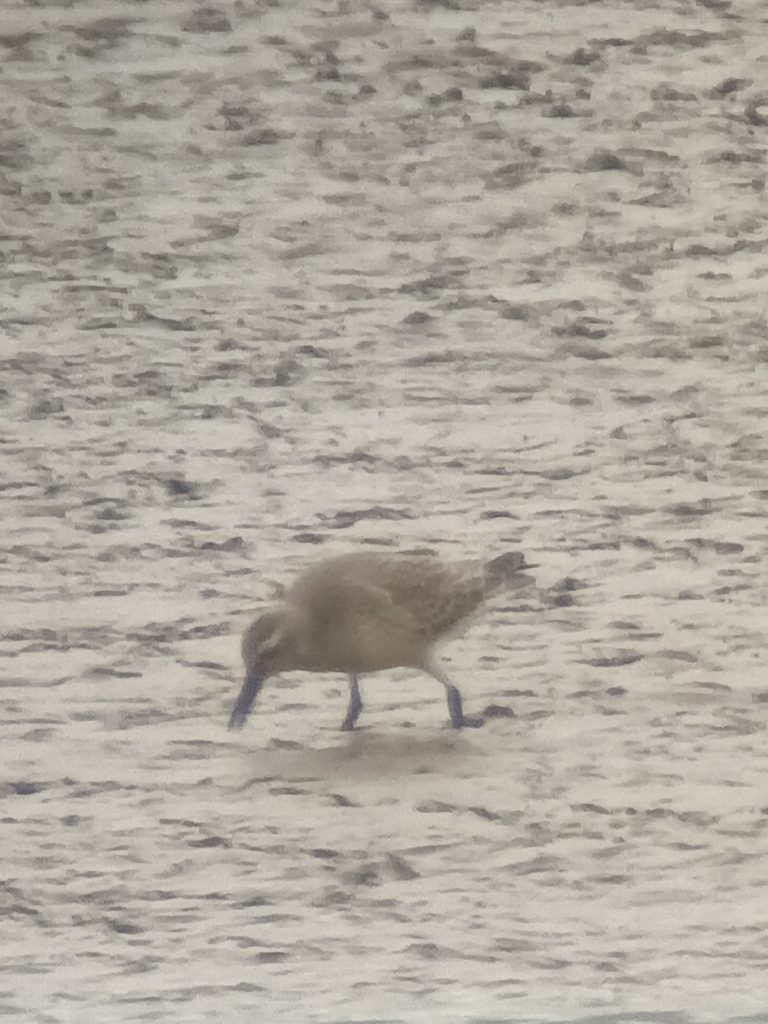
Hanging around we could also see and hear a flock of about 20 Linnet. Eventually someone pointed out where the Pectoral Sandpiper had been seen in the past few minutes. Was it going to be a question of “you should have been here five minutes ago”? The bird had been roosting, but seemed to have vanished. Then JB located it wandering around by the water’s edge and up on to the shore. It kept moving along the shoreline, but everyone got onto it in the end.

We had also been told that there was a Garganey and a Pintail in amongst the ducks roosting on distant spits near the far end of the causeway. We did, of course, have to check them out. We probably did see them among the hundreds of roosting birds, but had a better chance of keeping a snowball frozen in Hell than identifying those two birds. As we had walked we were still checking both basins and a couple of Black-necked Grebes were on the north basin. And so we set off back along the causeway, taking more time to check out and admire the waders. We also discovered at least one more Black-necked Grebe on the south basin. At some point a birder asked if we had seen the Black Tern. On being told we hadn’t, he delightedly pointed it out perched on a buoy near a tern raft close to the start of the causeway! As we started out we hadn’t seen the buoy, let alone the Black Tern.

As we headed back towards the cars, we decided that we would sit on the final bench for our lunch. This was closer to the buoy, although the tern seemed to have temporarily disappeared. While a couple of the group went to fetch lunch from the cars we were idly looking around when four small waders arrived on the causeway bank oof the north basin. With clearer views these were readily identified as Sanderling in breeding plumage and quite unlike the pale birds we encounter scurrying along the tide line during winter birdwatching by the coast. Unfortunately, JB’s ‘scope decided to take a nose dive and as he retrieved it, he was not amused – the fixing on the tripod for the ‘scope had fractured in to and was unusable. No more scoping for him. It wasn’t too much of an issue as no new birds (apart from a lone Feral Pigeon) were on offer. The Black Tern was relocated flying and dip feeding giving reasonable views through binoculars until it flew close by and resettled on its favoured buoy. We had decided to call it a day, apart from checking fences, etc in case the Whinchat that had been reported earlier put in appearance. It didn’t. an so we said our goodbyes and headed home. One more species was added for the day; SF had to get some petrol and we drove round to a supermarket petrol station by Ashford Hospital. A Woodpigeon put in an appearance on the reservoir side of the road, so we decided it could be counted.
Species list
37 bird species
Canada Goose, Greylag Goose, Mute Swan, Shoveler, Gadwall, Mallard, Teal, Tufted Duck, Feral Pigeon, Woodpigeon, Coot, Little Grebe, Great Crested Grebe, Black-necked Grebe, Ringed Plover, Black-tailed Godwit, Knot*, Ruff*, Curlew Sandpiper*, Sanderling*, Dunlin, Little Stint*, Pectoral Sandpiper, Black Tern*, Black-headed Gull, Great Black-backed Gull, Lesser Black-backed Gull, Cormorant, Grey Heron, Red Kite, Magpie, Carrion Crow, Swallow, Starling, Yellow Wagtail*, Pied Wagtail, Linnet